
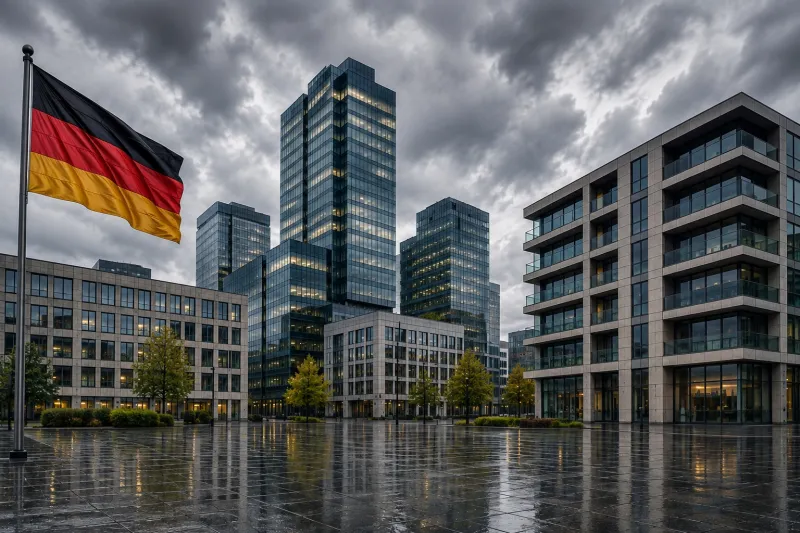
Germany’s commercial property market loses momentum as prices slide in uncertain economy
Germany’s commercial real estate sector is under renewed pressure as falling valuations collide with weak growth, tighter financing and cautious occupiers. After years of cheap debt supporting pricing, investors and lenders are now recalibrating risk, while owners face tougher refinancing terms and higher requirements for energy upgrades. The result is a market where price discovery is slow, transaction volumes remain subdued and the gap between prime assets and everything else is widening.
- A market caught between repricing and paralysis
- Economic uncertainty reshapes risk appetite
- Higher interest rates drive yield expansion
- Banks tighten lending and scrutinize collateral
- Office sector faces a demand reset
- Retail remains uneven as formats diverge
- Logistics offers resilience but not immunity
- Energy standards and retrofit costs hit valuations
- Transaction volumes fall as price discovery drags on
- What investors are prioritizing now
A market caught between repricing and paralysis
Commercial property prices in Germany have been declining as investors demand higher yields to compensate for elevated interest rates and economic uncertainty. Many sellers are reluctant to accept lower bids, while buyers wait for clearer signals on where valuations will settle. This stand-off depresses deal activity and prolongs repricing, especially in segments where cash flows are perceived as less resilient or where capex needs are uncertain.
The dynamic is most visible in secondary locations and older buildings, where liquidity evaporates quickly once debt becomes more expensive. In contrast, a smaller pool of capital still targets best-in-class assets, but often only at meaningfully discounted prices compared with peak-cycle levels.
Economic uncertainty reshapes risk appetite
Germany’s macro backdrop has become a key variable in underwriting. Slower industrial activity, uneven consumer spending and persistent cost pressures make future rental growth harder to forecast. Investors who once relied on steady expansion now focus on downside scenarios such as tenant consolidation, delayed leasing decisions and higher vacancy in cyclical industries.
Uncertainty also raises the value of visibility: long leases, strong covenants and essential-use properties command a premium. Assets linked to discretionary demand or exposed to structural shifts, such as some retail formats and commodity office stock, face steeper yield expansion and sharper valuation cuts.
Higher interest rates drive yield expansion
With financing costs materially above the ultra-low levels of the previous decade, buyers are adjusting their required returns. Even if rents remain stable, higher discount rates reduce present values, translating into lower prices. For leveraged investors, the change is amplified: debt service consumes a larger share of net operating income, squeezing equity returns unless entry pricing drops.
This shift pressures assets bought at peak pricing with floating-rate debt or short-term hedges. Where interest-rate protection rolls off, owners may be forced to refinance at higher coupons, inject equity or sell into a softer market.
Banks tighten lending and scrutinize collateral
German and European lenders have become more conservative on loan-to-value ratios, interest coverage requirements and tenant quality. Valuation haircuts, lower leverage and shorter loan tenors reduce purchasing power and shrink the pool of eligible borrowers. In parallel, lenders are increasing due diligence on business plans, particularly where leasing risk or renovation requirements are material.
Refinancing risk is rising for assets originated under looser assumptions. Borrowers facing maturity walls may encounter demands for amortization, additional collateral or partial paydowns, which can precipitate distressed sales for owners without sufficient liquidity.
Office sector faces a demand reset
Office markets are contending with slower hiring, corporate cost control and the ongoing normalization of hybrid work. While Germany’s prime CBD locations can still attract tenants seeking quality and accessibility, occupiers are often shrinking footprints, prioritizing flexibility and upgrading to higher-spec space rather than expanding overall area.
This produces a bifurcation: prime, energy-efficient buildings in strong submarkets maintain relatively better occupancy and pricing, while aging stock with weaker sustainability credentials struggles. Landlords of older assets face higher incentives, longer void periods and the prospect of major repositioning to stay competitive.
Retail remains uneven as formats diverge
Retail performance varies sharply by location and concept. Grocery-anchored centers and convenience-led schemes tend to hold up better, supported by daily-needs spending and footfall stability. By contrast, discretionary-focused retail and weaker high streets can suffer from cautious consumers, high operating costs and continued e-commerce pressure.
Investors are therefore selective, underwriting conservative rental growth and higher capex. Assets with re-leasing risk or tenant concentration issues see sharper repricing, while well-located properties with adaptable layouts remain more liquid, albeit at higher yields than in the past.
Logistics offers resilience but not immunity
Logistics has been one of the more resilient segments due to long-term e-commerce penetration, supply chain reconfiguration and limited land availability near major hubs. However, even this sector is not insulated from the broader repricing. Higher yields and more disciplined underwriting have cooled exuberant pricing, and tenant demand can soften when trade volumes and manufacturing output weaken.
That said, modern facilities in core corridors with strong specifications and power capacity remain attractive. The key difference is that repricing often reflects the new cost of capital rather than a collapse in fundamentals.
Energy standards and retrofit costs hit valuations
Environmental performance has moved from a reputational issue to a financial one. Buildings that lag on energy efficiency face higher operating costs, reduced tenant appeal and, in some cases, constraints tied to regulations or lender ESG policies. Investors increasingly discount assets with uncertain retrofit pathways, especially where payback periods are long or construction costs are volatile.
Owners are being forced to prioritize capital plans: insulation, HVAC upgrades, smart metering and facade improvements can be necessary to defend rents and liquidity. Where capex requirements are large relative to income, valuations can fall disproportionately because buyers price in both the cost and the execution risk.
Transaction volumes fall as price discovery drags on
Lower deal activity is both a symptom and a cause of market weakness. With fewer comparable transactions, valuations become harder to anchor, widening bid-ask spreads. Many investors prefer to wait, expecting further price adjustments or clearer guidance on interest rates and growth, while some owners hold assets in the hope of refinancing relief.
Where deals do happen, they often involve motivated sellers, portfolio rebalancing or situations where refinancing timelines force action. As a result, reported prices can appear volatile, reflecting a mix of prime trades and discounted transactions for challenged properties.
What investors are prioritizing now
In today’s environment, investors focus on durability and control. Core criteria often include stable cash flows, diversified tenant bases, manageable lease expiries and credible capex planning. Underwriting assumptions are more conservative, emphasizing downside protection over aggressive growth.
Common priorities in Germany’s current market
- Quality and location that support leasing even in a slowdown
- Sustainable specifications and clear retrofit strategies
- Lower leverage and longer-term financing certainty
- Tenant resilience and limited concentration risk
- Operational flexibility to reposition space if demand shifts
As pricing adjusts, opportunities may emerge for well-capitalized buyers. Still, the playbook has changed: value creation increasingly depends on asset management, redevelopment expertise, and careful balance-sheet planning rather than broad market appreciation.
Writer focused on delivering informative, accessible content