UAE real estate starts 2026 strong as Dubai faces mounting oversupply pressure
UAE property markets have entered 2026 with notable momentum, supported by population inflows, resilient tourism, and ongoing capital formation across the federation. Yet beneath the strong headline demand, Dubai is moving into a more delicate phase: a large development pipeline is converging with affordability constraints and shifting buyer preferences, raising the risk of localized oversupply. The result is a market that still looks healthy at the top level, but increasingly requires investors, developers, and lenders to differentiate by location, asset quality, and delivery timing.
- A strong start for the UAE, but a split market story
- What is driving demand in 2026
- Dubai’s supply pipeline and where oversupply is most likely
- Pricing is shifting from broad gains to selective resilience
- Rents and yields under pressure in high-completion zones
- Off-plan dynamics: Payment plans meet tighter end-user math
- How Abu Dhabi and the Northern emirates are positioning
- Policy, regulation, and transparency effects on 2026 sentiment
- What developers are doing to defend absorption
- Investor playbook for 2026: Focus on scarcity, cash flow, and delivery risk
A strong start for the UAE, but a split market story
Early-2026 indicators point to firm transaction activity and continued liquidity in the UAE, with end-user demand holding up better than many expected after rapid price gains in prior years. At the same time, performance is diverging across emirates and within Dubai itself. Prime, well-connected communities continue to attract both residents and international buyers, while some peripheral submarkets show early signs of softer absorption. This split underscores a key theme for 2026: the UAE can be strong overall even as Dubai confronts oversupply pressure in specific segments.
What is driving demand in 2026
Demand is being fueled by a combination of structural and cyclical factors. Population growth remains a core driver, reinforced by employment creation in services, technology, logistics, and financial activities. Tourism and business travel continue to support short-term rental economics in established areas, while lifestyle migration keeps interest elevated for family-oriented villas and well-managed communities. In addition, the UAE’s reputation for safety, infrastructure, and predictable regulation continues to attract cross-border capital seeking diversification. These forces help explain why many projects are still selling, even as the supply pipeline thickens.
Dubai’s supply pipeline and where oversupply is most likely
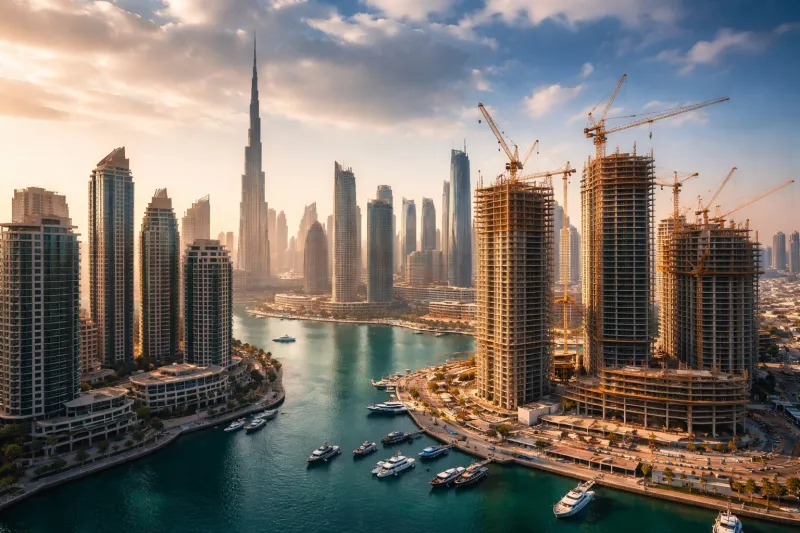
Oversupply risk in Dubai is less about a single citywide glut and more about the concentration of too many similar units completing in the same time window and competing for the same tenant and buyer pools. The most vulnerable pockets tend to be those with high density, heavy investor ownership, and limited differentiation beyond price. In such areas, competition can quickly shift from marketing perks to outright price concessions, especially if multiple towers or phases hand over simultaneously. By contrast, supply additions in established, amenity-rich neighborhoods often absorb better, particularly when projects offer superior layouts, parking ratios, and community infrastructure.
Pricing is shifting from broad gains to selective resilience
After a period when rising demand lifted most boats, 2026 is showing a more selective pricing environment. Prime homes with strong views, efficient floorplans, and proven developer quality are holding value more consistently, while secondary units face tougher negotiations. As more handovers occur, sellers of comparable stock may be forced to compete on closing costs, payment flexibility, or furnishing packages. This does not automatically imply a sharp market correction; rather, it points to a phase where price discovery becomes granular, with outcomes determined by micro-location and building reputation.
Rents and yields under pressure in high-completion zones
Rental markets typically feel supply increases faster than sales markets, and 2026 is reinforcing that dynamic. In areas where multiple projects are delivering, tenants gain bargaining power through greater choice, pushing landlords toward incentives such as rent-free periods, flexible cheques, or upgraded maintenance terms. Where rents flatten or decline while service charges remain sticky, net yields compress. Investors underwriting new purchases should therefore model more conservative rent growth assumptions and stress-test vacancy periods, particularly for studios and one-bedroom units in high-density corridors.
Off-plan dynamics: Payment plans meet tighter end-user math
Off-plan sales remain a central feature of Dubai’s market structure, but the buyer mix is evolving. Attractive payment plans can sustain headline sales volumes, yet end-user affordability is becoming a more binding constraint as prices and living costs have risen. For investors, the key question is whether projected rental income and resale values at handover will justify the all-in cost once service charges, furnishing, and financing are included. In 2026, projects that rely primarily on speculative flipping are more exposed, while developments that appeal to genuine occupiers through practical sizes, family amenities, and realistic pricing tend to show more stable demand.
How Abu Dhabi and the Northern emirates are positioning
As Dubai wrestles with pockets of oversupply, other emirates are benefiting from spillover interest and differentiated demand. Abu Dhabi’s market is supported by government-linked employment, long-term institutional activity, and a more measured delivery cadence in certain districts, which can reduce immediate oversupply risk. Meanwhile, parts of the Northern emirates are increasingly marketed as value alternatives for residents prioritizing space and affordability, particularly where connectivity improvements and new community developments are underway. This broader UAE backdrop helps keep federation-wide sentiment constructive even if Dubai’s trajectory becomes more uneven.
Policy, regulation, and transparency effects on 2026 sentiment
Market confidence in the UAE continues to be shaped by regulatory clarity and transaction transparency. Efforts that strengthen escrow discipline, improve data availability, and enforce developer delivery standards can mitigate the worst effects of speculative excess. Equally important is how the market communicates supply: better visibility into handover schedules and unit mixes allows buyers and lenders to price risk more accurately. In an oversupply-sensitive environment, credibility becomes a competitive advantage for developers, brokers, and platforms that provide consistent, verifiable information.
What developers are doing to defend absorption
Developers are responding to intensifying competition with both product and commercial levers. On the product side, many are refining unit layouts, increasing storage, improving acoustic performance, and adding community features that support daily living rather than just branding. On the commercial side, incentives are becoming more creative, including extended payment schedules, DLD fee support, guaranteed returns on limited tranches, and bundled furnishing. However, these tools can mask underlying pricing pressure, so buyers should distinguish between genuine value creation and headline discounts that may reappear later in the resale market.
Investor playbook for 2026: Focus on scarcity, cash flow, and delivery risk
In 2026, a disciplined approach is increasingly rewarded. Investors are prioritizing assets with durable scarcity, such as prime locations, unique views, larger family formats, or low-density community planning where supply is harder to replicate. Cash-flow underwriting is also tightening, with greater attention to net yields after service charges, maintenance, and realistic leasing timelines. Finally, delivery risk is back at the center of due diligence: buyers are scrutinizing developer track records, escrow compliance, handover schedules, and the competitive supply coming online nearby. Practical screening criteria can include:
- Submarket supply: expected completions within a 1–3 km radius over the next 24 months
- Building fundamentals: parking, elevators, maintenance standards, and service-charge history
- Exit options: resale liquidity versus reliance on short-term rental performance
- Tenant depth: proximity to employment hubs, schools, transit, and daily amenities
Writer focused on delivering informative, accessible content