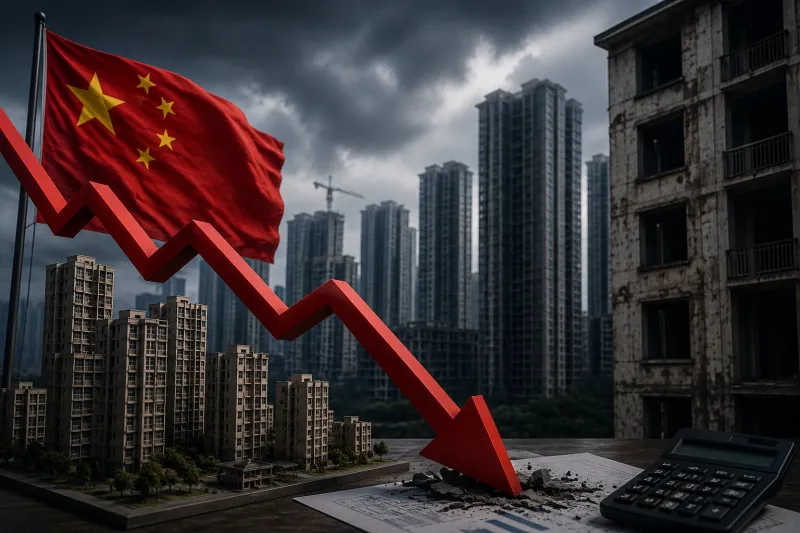

China’s slowdown sends shockwaves through global property markets
China’s economic slowdown is no longer a domestic story confined to weaker consumption and softer industrial output. It is increasingly a global property market issue, reshaping capital flows, construction demand, leasing decisions, and risk pricing across regions. As investors reassess exposure to China-linked growth and developers face tighter funding conditions, the knock-on effects are emerging in everything from office vacancy assumptions to logistics pipeline timing and prime residential demand in international gateway cities.
- Why China’s slowdown matters to global real estate pricing
- Capital flows shift as Chinese buyers and institutions retreat
- Funding stress and risk repricing across developers and lenders
- Construction pipelines feel the impact through materials and supply chains
- Office markets face second-order effects via corporate confidence
- Industrial and logistics: softer trade can cool demand, but not evenly
- Residential demand in global cities may weaken as wealth effects spread
- Commodities, inflation, and interest rates: the macro channel to cap rates
- Asia-Pacific spillovers: tourism, education, and retail fundamentals
- What investors are watching now: signals that can move valuations quickly
Why China’s slowdown matters to global real estate pricing
Real estate is heavily influenced by expectations for growth, inflation, and financing costs, and China affects all three through trade, commodity demand, and cross-border investment behavior. When China slows, global growth forecasts often get revised down, which can reduce projected rental growth and increase required yields. At the same time, weaker Chinese demand can cool commodity prices, affecting construction costs and the inflation path that central banks respond to indirectly by changing mortgage rates and cap rates. The result is a more uncertain pricing environment where valuations can gap between sellers anchored to past comps and buyers underwriting more cautious scenarios.
Capital flows shift as Chinese buyers and institutions retreat
Many global markets became accustomed to Chinese outbound capital supporting trophy assets and prime residential segments. With slower growth, tighter domestic liquidity, and heightened scrutiny of capital movement, outbound acquisitions can soften or become more selective. That can remove a marginal bid in cities that relied on foreign demand to sustain premium pricing, particularly for high-end apartments and landmark commercial properties. For managers raising global real estate funds, a reduced China allocation can also mean different pacing of commitments and a greater emphasis on liquidity, pushing investors toward core, income-resilient assets rather than development-heavy strategies.
Funding stress and risk repricing across developers and lenders
Concerns around Chinese property-sector balance sheets have contributed to broader caution among lenders and bond investors toward real estate credit risk. Even outside China, banks and private lenders may tighten terms for development loans, increase spreads, or lower loan-to-value ratios when global risk appetite deteriorates. This can delay projects, reduce land bidding, and push more sponsors to seek joint ventures or preferred equity. In markets already dealing with higher rates, the incremental risk premium linked to China-related uncertainty can further compress feasibility for speculative office and large-scale residential developments.
Construction pipelines feel the impact through materials and supply chains
China’s role in global manufacturing makes its slowdown relevant to construction inputs and delivery timelines. Lower demand can ease prices for certain materials, but it can also create volatility as producers adjust output and as shipping patterns change. Developers may see short-term relief in some input costs while still facing uncertainty in specialized components and equipment. In underwriting, this encourages a more conservative approach to contingencies and completion schedules, especially for complex assets like data centers and logistics facilities that depend on reliable equipment lead times.
Office markets face second-order effects via corporate confidence
Office demand is sensitive to corporate hiring, expansion plans, and cross-border trade volumes areas that can weaken when China’s growth slows. Multinationals with China-exposed revenues may reduce footprints, delay relocations, or renegotiate leases, adding to vacancy pressures in certain business districts. Gateway markets that host regional headquarters for Asia-facing firms can feel this more acutely, particularly where remote-work dynamics have already weakened absorption. For landlords, the key risk is not just lower net effective rents but higher incentives and capex required to secure tenants in a more cautious corporate environment.
Industrial and logistics: softer trade can cool demand, but not evenly
Logistics real estate is closely tied to trade flows, inventory strategies, and e-commerce volume. A China slowdown can reduce certain import categories and manufacturing throughput, pressuring some port-adjacent and distribution submarkets. However, the effect is uneven: supply-chain diversification and nearshoring can redirect demand toward alternative manufacturing hubs, supporting logistics growth in regions that capture new capacity. Investors are therefore differentiating between assets dependent on China-heavy trade lanes and those positioned for broader regional consumption or reshoring trends.
Residential demand in global cities may weaken as wealth effects spread
Prime residential markets in cities such as London, Vancouver, Sydney, and parts of Southeast Asia have historically been influenced by international buyers, including Chinese households. Slower growth and softer asset values at home can reduce discretionary demand for overseas property, while currency moves can further affect affordability. In addition, families may prioritize liquidity and domestic opportunities over foreign purchases. This can translate into longer selling times, more negotiation on price, and a shift in demand from trophy assets toward properties with clearer rental economics.
Commodities, inflation, and interest rates: the macro channel to cap rates
One of the most consequential linkages is how China’s demand influences global commodity prices and, by extension, inflation. If a slowdown contributes to disinflation, some central banks may find room to ease policy earlier than expected, which can support real estate values through lower discount rates. Yet markets can also interpret weaker growth as higher credit risk, keeping spreads wide even if base rates fall. For property markets, that mix can produce a scenario where financing costs decline slowly while income expectations are marked down—leading to a complex, sector-by-sector repricing rather than a uniform rebound.
Asia-Pacific spillovers: tourism, education, and retail fundamentals
In parts of Asia-Pacific, Chinese consumer activity is a meaningful driver of retail sales, hotel occupancy, and certain service-sector jobs that support housing demand. A slower China can weaken outbound tourism and discretionary spending, affecting revenue per available room and retailer leasing appetite in destination markets. Education-linked migration patterns can also soften if household budgets tighten or if currency moves reduce affordability. These demand shifts matter for retail and hospitality underwriting, where small changes in footfall and occupancy can have outsized effects on net operating income.
What investors are watching now: signals that can move valuations quickly
Investors are tracking a set of indicators that can rapidly change market sentiment and deal pricing. Key watchpoints include:
- China credit conditions, including developer refinancing ability and bank lending appetite
- Renminbi and regional currency moves, which affect cross-border purchasing power
- Export and import trends, especially for markets tied to ports, manufacturing, and logistics
- Commodity price direction, influencing construction budgets and inflation expectations
- Policy signals on stimulus, housing support, and capital flow management
These signals feed directly into underwriting assumptions: rent growth, exit yields, leasing velocity, and construction timelines, making the market more sensitive to macro surprises and increasing the value of conservative structuring, stronger covenants, and assets with durable cash flows.
Writer focused on delivering informative, accessible content