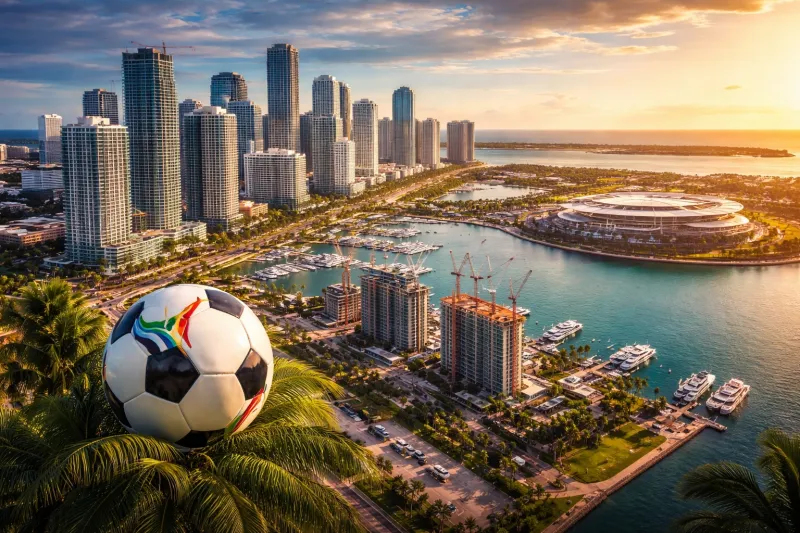
Miami’s next property boom: How the 2026 FIFA World Cup could reshape real estate
When the 2026 FIFA World Cup comes to the U.S., Miami is positioned to capture a disproportionate share of the economic and cultural spillover—from matchday crowds to media attention and corporate hospitality. Even though games are played at Hard Rock Stadium in nearby Miami Gardens, the region’s tourism corridors, luxury neighborhoods, and development pipeline are tightly interconnected. For buyers, sellers, developers, and renters, the tournament could act as a catalyst that accelerates trends already underway in Miami’s real estate market.
- 1) A short-term demand shock for rentals and hospitality-linked housing
- 2) Price momentum in neighborhoods tied to stadium access and commuter routes
- 3) Development acceleration around mixed-use districts and entertainment corridors
- 4) Infrastructure and public realm upgrades that change neighborhood desirability
- 5) Global visibility that expands Miami’s buyer pool
- 6) A boost to luxury markets via corporate hospitality and high-net-worth travel
- 7) Pressure on affordability and the risk of displacement in key areas
- 8) Retail and commercial spillovers that influence residential values
- 9) Investor strategy shifts: From pure appreciation to flexible-use assets
- 10) Post-tournament hangover or durable uplift? What will determine the market’s direction
1) A short-term demand shock for rentals and hospitality-linked housing
Major sporting events typically trigger a surge in short-stay demand, and Miami’s inventory of vacation rentals, furnished condos, and extended-stay units could see a meaningful spike during the tournament window. That demand can ripple into the broader rental market as owners temporarily pivot units from long-term leasing to short-term stays, tightening availability and pushing up asking rents in certain submarkets.
Neighborhoods with strong visitor appeal and easy access to transit corridors such as Downtown/Brickell, Wynwood, Miami Beach, and areas along I-95 and the Turnpike may experience the sharpest fluctuations. The result is often a temporary premium for furnished, turnkey units, which can influence investor preferences well beyond the event itself.
2) Price momentum in neighborhoods tied to stadium access and commuter routes
Although the matches occur in Miami Gardens, the real estate impact is rarely confined to a single municipality. Properties that align with practical travel patterns near major arterials, reliable ride-share access, and entertainment clusters can benefit from improved visibility and perceived convenience.
Areas such as Miami Gardens, North Miami, Aventura, and parts of Broward that connect efficiently to the venue may see increased interest from value-seeking buyers and investors. The biggest impact may be in mid-market single-family homes and small multifamily, where pricing is still accessible relative to prime waterfront districts yet close enough to capture demand from visitors and event-driven workers.
3) Development acceleration around mixed-use districts and entertainment corridors
Large events tend to speed up planning decisions and pull forward timelines for projects already in the pipeline. In Miami, that could mean faster delivery of mixed-use developments combining residential units, retail, offices, and hospitality. Developers may also lean into designs that support flexible usage of lobby and amenity spaces that work for both residents and short-stay guests.
Expect renewed attention on districts with established nightlife, dining, and cultural gravity. A World Cup-driven marketing halo can help projects compete for capital, tenants, and buyers, especially when paired with a narrative of Miami as an international gateway city.
4) Infrastructure and public realm upgrades that change neighborhood desirability
Cities and regions often invest in mobility, streetscapes, signage, security, and venue-area improvements when global events approach. Even modest upgrades, such as better lighting, pedestrian safety measures, improved wayfinding, and enhanced transit operations, can have outsized effects on how neighborhoods are perceived and used.
In real estate, perception quickly translates into pricing. If event preparation drives improvements to corridors that connect visitors to beaches, downtown, and the stadium area, adjacent residential pockets can see a lift in demand. Over time, better connectivity and public realm quality can support higher valuations, particularly for properties within a comfortable walk or short ride of upgraded routes.
5) Global visibility that expands Miami’s buyer pool
The World Cup is a global broadcast event that reinforces Miami’s brand to international audiences. For real estate, brand matters: it shapes relocation choices, second-home decisions, and capital allocation by overseas investors. Miami already attracts buyers from Latin America, Europe, and Canada; a tournament spotlight can broaden that funnel and refresh it with new cohorts.
International buyers often gravitate toward newer condos, trophy waterfront properties, and amenity-rich buildings. Increased attention can also raise competition for limited inventory, especially in neighborhoods that signal lifestyle and status, such as Miami Beach, Brickell, Coconut Grove, and select waterfront enclaves.
6) A boost to luxury markets via corporate hospitality and high-net-worth travel
World Cup matches generate corporate hospitality demand, private events, and premium travel. That ecosystem favors high-end accommodations and can spill into the luxury home market through short-term leasing of upscale residences, heightened demand for penthouses, and increased visibility for branded residential towers.
Luxury markets are especially sensitive to narrative and momentum. If Miami is portrayed as a safe, vibrant, and globally connected host, it can reinforce the city’s position in the competitive set of “international lifestyle capitals,” potentially strengthening pricing power for the most scarce assets: waterfront lots, new construction with premium views, and architecturally distinctive homes.
7) Pressure on affordability and the risk of displacement in key areas
Event-driven demand can exacerbate affordability challenges, particularly where supply is constrained. If landlords shift units to short-term rentals or raise rents in anticipation of higher demand, cost burdens can intensify for residents. This is most acute in neighborhoods already experiencing rapid change, where incomes have not kept pace with housing costs.
Municipal responses such as enforcement of short-term rental rules, tenant protections, or incentives for workforce housing can shape the net outcome. For investors and developers, understanding local policy direction becomes essential: regulatory changes can influence returns as much as market demand.
8) Retail and commercial spillovers that influence residential values
Commercial real estate can benefit from tournament-related foot traffic, pop-up concepts, sponsorship activations, and expanded nightlife demand. When retail corridors strengthen through higher sales, new tenants, and upgraded storefronts, nearby residential values often follow, because daily convenience and neighborhood vibrancy increase.
Submarkets that can host fan experiences, brand events, and media gatherings may see a wave of leasing activity for short-term commercial space. Over time, successful concepts can become permanent, improving the amenity base that supports higher rents and stronger condo resale demand.
9) Investor strategy shifts: From pure appreciation to flexible-use assets
In anticipation of event-driven demand, some investors prioritize properties that can toggle between use cases: long-term rental, corporate housing, and short-term stays (where permitted). This favors layouts that rent well-furnished, buildings with strong management, and locations with year-round demand drivers, not just event proximity.
Common selection criteria may include:
- Walkability to dining and entertainment
- Building policies that clearly define leasing flexibility
- Low friction operations (parking, security, maintenance)
- Resilience to seasonality through diversified demand
As more capital targets these traits, pricing can rise in buildings and micro-neighborhoods that offer operational simplicity and consistent tenant appeal.
10) Post-tournament hangover or durable uplift? What will determine the market’s direction
Not all event impacts are lasting. A key question for Miami real estate is whether the World Cup creates only a temporary surge or whether it reinforces durable fundamentals like job growth, migration, infrastructure quality, and international demand. The difference often comes down to supply: if a wave of new units delivers all at once, pricing power can soften; if supply remains constrained, the event can amplify existing upward pressure.
Other determinants include financing conditions, insurance costs, climate resilience investment, and local regulation of short-term rentals. In practical terms, stakeholders will watch the same indicators that shape any cycle inventory, absorption, days on market, rent growth, and cap rates while tracking how the World Cup changes Miami’s visibility and spending patterns across multiple seasons.
Writer focused on delivering informative, accessible content