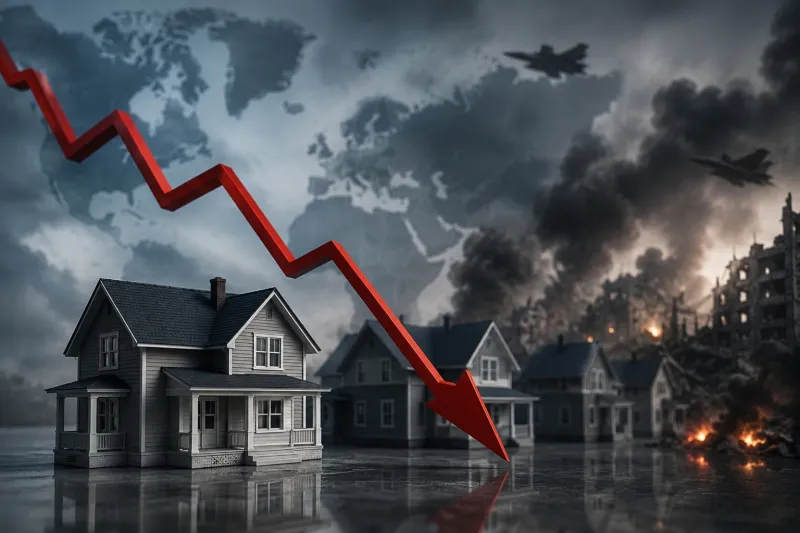

Iran war fears slash UK house price growth forecast in half
Escalating conflict risk involving Iran is rippling far beyond the Middle East, and UK housing is feeling the shock. With energy markets on edge, inflation expectations twitching and interest-rate paths suddenly less predictable, several forecasters have pared back their outlook for UK house price growth—some cutting projections by around half as a direct response to the renewed geopolitical risk premium.
- Why a distant conflict hits UK property forecasts
- Energy prices are the fastest transmission channel
- Inflation expectations complicate the rate-cut narrative
- Mortgage rates react to gilt yields and risk sentiment
- Buyer confidence weakens before affordability does
- The UK labour market becomes the key swing factor
- Regional markets won’t move in lockstep
- Rental pressures may persist even as sales slow
- Banks and valuers turn cautious on marginal cases
- What would make forecasters upgrade again
Why a distant conflict hits UK property forecasts
UK house price forecasts depend heavily on assumptions about inflation, interest rates, wages and consumer confidence. A war involving Iran changes each of those inputs at once by injecting uncertainty into energy supply routes, raising the risk of higher fuel costs and destabilising global financial conditions. For UK lenders and buyers, that uncertainty translates into more cautious borrowing and slower transaction activity, which forecasters reflect by cutting expected annual price growth.
Energy prices are the fastest transmission channel
Even without direct UK involvement, markets tend to price in disruption risk around key shipping lanes and regional oil infrastructure. When crude and gas prices rise, households face immediate pressure through petrol, utilities and broader cost increases. That can reduce disposable income and weaken buyer affordability, especially for first-time buyers who already operate with tight margins. Forecasters often respond quickly because energy-led inflation can alter the trajectory of mortgage rates within weeks.
Inflation expectations complicate the rate-cut narrative
Prior to major geopolitical escalations, the UK property market often leans on the prospect of gradual interest-rate cuts to support demand. War-driven energy shocks can revive inflation fears, making central banks more reluctant to cut or at least slower to signal easing. The result is a reassessment of how far and how fast mortgage pricing can fall. A forecast that assumed multiple rate cuts over a year may be revised to fewer or later cuts, halving expected house price growth as the affordability improvement arrives more slowly.
Mortgage rates react to gilt yields and risk sentiment
UK mortgage pricing is tightly linked to gilt yields and swap rates, both of which can move sharply when investors reprice risk. In times of conflict, markets can swing between risk-off demand for safer assets and concern about inflation or fiscal pressures, producing volatile funding costs for banks. Lenders typically prefer stability; when volatility rises, they may widen margins, reduce the most aggressive deals or tighten criteria. That reduces the pool of buyers able to transact at previous price points, pulling down growth forecasts.
Buyer confidence weakens before affordability does
Housing is as much psychology as maths. Even if a household can technically afford a mortgage, the perception of geopolitical instability can prompt delays: buyers wait for clearer signals on rates, inflation, job security and fuel bills. Sellers may also hesitate, reducing listings and creating an uneven market where motivated buyers negotiate harder and average achieved prices soften. Forecasters interpret these confidence effects as slower price momentum, not necessarily a crash but a loss of the earlier “gentle recovery” narrative.
The UK labour market becomes the key swing factor
Most housing downturns become severe only when unemployment rises materially. A war shock raises recession risk through higher input costs and weaker global demand, but the UK outcome depends on how businesses respond. If firms freeze hiring, cut bonuses or reduce hours, buyers’ willingness to stretch on mortgage multiples declines. Forecasts that were based on steady real wage growth are often marked down when the labour outlook turns more fragile, because housing demand is highly sensitive to expected future income.
Regional markets won’t move in lockstep
A halved national forecast masks sharp regional differences. More expensive areas where price-to-income ratios are highest tend to be most exposed to rate and confidence shocks because small changes in mortgage costs have outsized effects on monthly payments. Conversely, markets with stronger rental demand, more resilient local employment, or lower entry prices may hold up better. In practice, a reduced national growth projection often implies a patchwork outcome: some regions flat, others modestly up, and pockets of weakness where affordability is stretched.
Rental pressures may persist even as sales slow
When buying becomes harder or riskier, demand can shift into renting, especially among first-time buyers. At the same time, higher financing costs and regulatory changes can discourage new landlord supply. That combination can keep rents elevated even if house price growth cools. For forecasters, sticky rent inflation matters because it feeds into broader inflation measures and household budgets, indirectly influencing the interest-rate environment that ultimately drives house price expectations.
Banks and valuers turn cautious on marginal cases
In uncertain periods, lenders often re-evaluate risk appetite. That can show up as stricter stress tests, lower maximum loan-to-income limits for some borrowers, or increased scrutiny of property types seen as higher risk. Valuers may also become more conservative if comparable sales are thin or if prices appear to be softening. These frictions disproportionately affect chain-dependent buyers and higher loan-to-value applicants, reducing transaction volumes and dampening the price growth that forecasts rely on.
What would make forecasters upgrade again
Upward revisions typically require a clearer path for inflation and rates, plus stabilising energy prices. Signs that conflict risk is contained, shipping routes remain secure, and energy supply is uninterrupted would reduce the geopolitical risk premium priced into markets. Domestically, stronger-than-expected wage growth, improved mortgage competition, and a rebound in agreed sales could prompt forecasters to lift projections. Many analysts will watch a short list of indicators:
- Oil and gas price stability over several weeks
- Swap rates and the reappearance of lower fixed-rate mortgage deals
- Transaction volumes and time-to-sell data
- Real wage growth and unemployment trends
Writer focused on delivering informative, accessible content