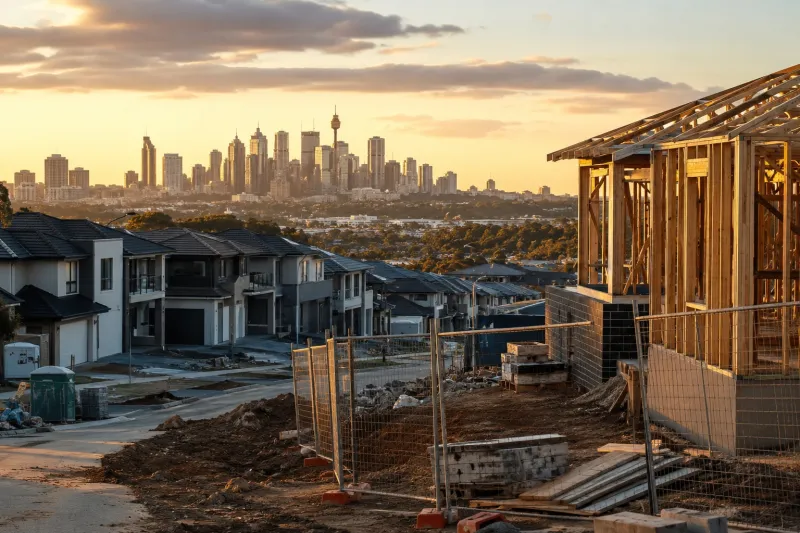
Australia’s housing crunch deepens as construction misses national targets
Australia’s housing shortage is intensifying as new home construction continues to lag behind population growth and policy ambitions. Despite national targets designed to accelerate supply, the pace of approvals, commencements, and completions is being constrained by high financing costs, trade shortages, planning delays, and fragile builder balance sheets. The result is a tightening market where rents rise faster, first-home buyers face steeper hurdles, and governments are forced to balance immediate relief with the long lead times of building.
- Targets are set, but the pipeline is not keeping up
- Population growth is outpacing completions
- Higher interest rates have cooled feasibility and financing
- Building costs and supply chain volatility still bite
- Workforce shortages limit how fast supply can expand
- Planning and approvals create bottlenecks before building even starts
- Builder insolvencies and contract risk are reshaping the market
- The rental market is where the shortage becomes most visible
- Policy responses mix short-term relief with long-term supply levers
- What needs to change to lift completions toward target levels
Targets are set, but the pipeline is not keeping up
Australia has articulated ambitious housing delivery goals through federal-state agreements and related policy packages, aiming to lift the overall number of homes built over the coming years. However, meeting a target is ultimately a function of the construction pipeline: land release, approvals, financing, workforce, materials, and final completion. Weakness at any stage reduces the flow of new stock. Recent cycles have shown that even when demand is strong, capacity constraints can prevent the industry from scaling, leaving a structural shortfall that compounds each year supply undershoots need.
Population growth is outpacing completions
Demand pressures are being magnified by rapid population growth, including a rebound in overseas migration and ongoing internal movements toward major job hubs. When household formation accelerates faster than dwelling completions, vacancy rates fall and competition for available rentals intensifies. The mismatch is especially acute in capital cities where employment and education opportunities cluster. Over time, persistent gaps translate into overcrowding, longer commutes as households search further from city centers, and delayed household formation as younger people stay longer in shared housing or with family.
Higher interest rates have cooled feasibility and financing
Construction is highly sensitive to borrowing costs because projects rely on a chain of finance: developers fund land and pre-construction, builders manage cash flow across progress payments, and buyers often need mortgages to settle at completion. Higher interest rates raise holding costs, reduce borrowing capacity, and make some projects unviable under existing sales price assumptions. This dynamic affects both apartment developments and greenfield housing, delaying new starts. It also shifts risk onto builders and subcontractors as margins thin, increasing the likelihood of disputes, delays, or project redesigns.
Building costs and supply chain volatility still bite
While some materials inflation has eased from pandemic peaks, the sector continues to grapple with elevated input costs and uncertainty. Price volatility makes fixed-price contracts difficult to price accurately, encouraging more conservative bidding or contract terms that push risk toward clients. Projects can also face longer lead times for key components, from windows and electrical equipment to prefabricated elements. When costs rise faster than sale prices or rents, developments stall. Even where demand is unquestioned, feasibility becomes the gatekeeper to whether homes actually get built.
Workforce shortages limit how fast supply can expand
Housing targets assume the industry can scale production, but chronic shortages of skilled trades and site supervisors constrain throughput. Competition for labour is intense across residential building, infrastructure projects, and commercial construction, often in the same regions. Training pipelines take years to translate into productive capacity, and productivity can suffer when crews are stretched. The shortage is not only about headcount; it also involves experience and coordination, which influence defect rates, rework, and the time it takes to complete each dwelling.
Planning and approvals create bottlenecks before building even starts
Long approval times and complex planning regimes slow the transition from concept to commencement, particularly for medium- and high-density projects. Delays can be caused by rezoning processes, community objections, infrastructure sequencing, and multiple layers of assessment. Each month added to timelines increases financing costs and heightens exposure to market shifts. When approvals are uncertain, developers may defer applications or stage projects more cautiously. Speeding up decision-making without compromising safety and amenity is therefore central to closing the supply gap.
Builder insolvencies and contract risk are reshaping the market
A wave of builder collapses in recent years has left a lasting imprint on consumer confidence and industry risk settings. Lenders and insurers have tightened requirements, and developers may prefer larger, better-capitalised contractors, reducing competition. Fixed-price contracts signed in a period of lower costs have proven dangerous when inputs jump, and many firms have responded by raising prices or shifting to cost-plus arrangements. These adjustments can protect builders but they can also push more risk onto clients, complicating sales and slowing the rate at which projects reach financial close.
The rental market is where the shortage becomes most visible
Low vacancy rates translate quickly into rent increases, shorter leasing times, and tougher application standards. For households on lower and moderate incomes, this can mean higher rent-to-income ratios, frequent moves, or acceptance of poorer quality housing. Essential workers may be priced out of areas close to jobs, affecting local labour markets. The pressure is not evenly distributed: inner-city markets may tighten due to student demand, while suburban and regional areas can see sharp swings depending on construction levels and employment conditions.
Policy responses mix short-term relief with long-term supply levers
Governments are pursuing a mix of measures, but these operate on different timelines. Immediate interventions often focus on rental assistance, tenancy reforms, and targeted support for vulnerable households. Medium-term levers include accelerating land release, improving planning efficiency, and investing in enabling infrastructure such as transport links and utilities. Long-term strategies aim to expand social and affordable housing and to boost construction capacity through skills programs and migration settings. The challenge is ensuring policies do not simply shift demand forward without adding net supply.
What needs to change to lift completions toward target levels
Closing the gap between targets and delivered homes requires coordinated improvements across the entire system. Key priorities often cited by industry and economists include:
- Faster, more predictable approvals so projects can be financed with greater certainty.
- More diverse housing typologies including well-located medium density, build-to-rent, and modular construction where appropriate.
- Workforce expansion and productivity gains through training, streamlined licensing pathways, and better site coordination.
- Risk settings that keep builders solvent, such as fairer contract terms and realistic pricing of contingencies.
- Infrastructure sequencing that aligns water, power, schools, and transport with new housing locations.
Without sustained progress on these fundamentals, the pipeline is likely to remain constrained, making it difficult for construction to catch up with Australia’s housing needs.
Writer focused on delivering informative, accessible content