
Dubai real estate steadies: Recovery momentum as Iran war risks ripple through the property sector
Dubai’s property market has shown renewed resilience, with transaction activity and pricing in several segments stabilizing after periods of volatility. Yet the regional security backdrop—shaped by war-related risks linked to Iran—has introduced a new layer of uncertainty for investors, developers, and tenants. This article examines how geopolitical stress is influencing sentiment, financing, and demand patterns, and why Dubai’s market mechanisms and policy toolkit are helping the sector absorb shocks while continuing to attract global capital.
- 1. Recovery signals in Dubai’s property cycle
- 2. How war risk affects property markets beyond headlines
- 3. Investor sentiment: From risk-off pauses to safe-haven reallocation
- 4. Capital flows and financing conditions under geopolitical stress
- 5. Demand shifts: Premium resilience vs. mid-market sensitivity
- 6. Rental market dynamics: Mobility, corporate leases, and pricing power
- 7. Developer strategy: Pricing discipline, phased launches, and project selection
- 8. Insurance, logistics, and operating costs: The hidden line items
- 9. Regulation and market infrastructure supporting stability
- 10. What buyers and sellers are doing differently right now
1. Recovery signals in Dubai’s property cycle
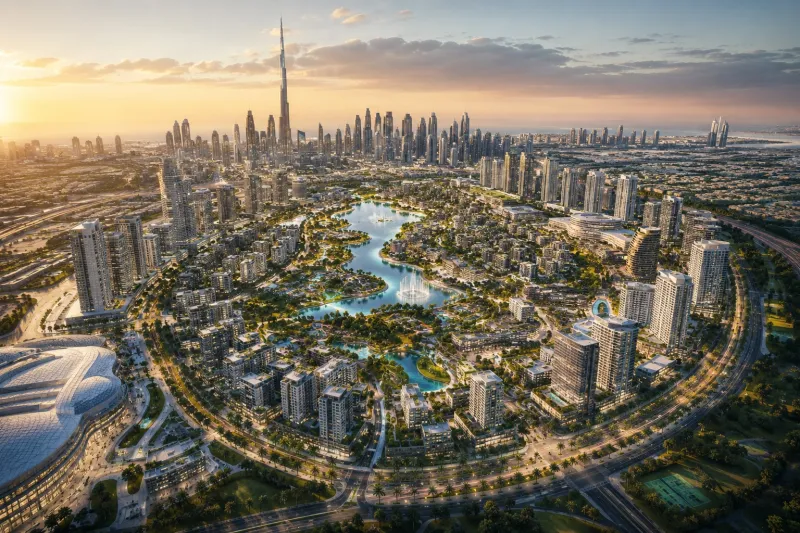
Dubai’s real estate recovery is being supported by a broad base of demand: end-users looking for long-term residency, international investors seeking yield and diversification, and corporates expanding regional footprints. In practical terms, recovery shows up as steadier price discovery, fewer distressed listings, and more balanced negotiations between buyers and sellers. Developers are also leaning toward phased launches and tighter inventory control, which can reduce the boom-bust dynamics that have historically amplified downturns.
2. How war risk affects property markets beyond headlines
War-related risks tied to Iran tend to impact real estate indirectly rather than through immediate physical disruption inside Dubai. The key transmission channels are confidence, cost of capital, insurance and shipping, and corporate hiring plans. Even when local fundamentals remain strong, elevated geopolitical uncertainty can lead to delayed purchase decisions, more conservative leverage, and greater preference for prime, liquid assets. As a result, the market often becomes more segmented: high-quality projects and prime locations stay relatively firm while secondary assets face wider spreads and slower absorption.
3. Investor sentiment: From risk-off pauses to safe-haven reallocation
In periods of regional tension, some investors shift temporarily into a risk-off stance, pausing acquisitions until the security outlook clarifies. At the same time, Dubai can benefit from a contrasting dynamic: reallocation from higher-risk jurisdictions into the UAE’s comparatively predictable legal environment and infrastructure. This creates a two-speed pattern where near-term hesitation coexists with medium-term inflows, particularly from buyers prioritizing asset protection, residency planning, and currency diversification.
4. Capital flows and financing conditions under geopolitical stress
Geopolitical risk can influence borrowing costs through global risk premia, bank underwriting standards, and the availability of cross-border funding. In Dubai, the effect is often less about a sudden credit freeze and more about stricter documentation, higher down-payment preferences, and a stronger focus on verified income and developer track record. For cash buyers, uncertainty may increase bargaining power; for leveraged buyers, it can narrow the pool of accessible deals. Developers may respond by emphasizing escrow discipline, construction progress transparency, and payment plans designed to keep absorption steady without overextending buyers.
6. Rental market dynamics: Mobility, corporate leases, and pricing power
Rental markets react quickly to shifts in population mobility and corporate leasing. If regional tensions encourage executives and entrepreneurs to base operations in the UAE, certain districts see stronger leasing demand and shorter vacancy cycles. Conversely, if uncertainty leads to delayed relocations, landlords may face more negotiation on renewals. The practical outcome is often micro-market volatility: some communities maintain pricing power due to limited supply and amenities, while others offer incentives such as flexible payment terms, minor upgrades, or shorter lease commitments to protect occupancy.
7. Developer strategy: Pricing discipline, phased launches, and project selection
Developers navigating a recovery under geopolitical pressure typically focus on execution credibility. That means prioritizing projects with proven end-user appeal, controlling new supply through phased releases, and maintaining pricing discipline rather than chasing volume. Many also strengthen buyer confidence through clearer construction timelines and after-sales service. Typical adjustments include:
- Smaller, staged inventory releases to match absorption
- More conservative land acquisition and tighter feasibility thresholds
- Product differentiation via community facilities, sustainability features, and smarter layouts
These measures can help the market sustain recovery even when external risks raise uncertainty.
9. Regulation and market infrastructure supporting stability
Dubai’s market stability is strengthened by its maturing regulatory and transactional infrastructure, which helps sustain confidence when regional conditions become noisier. Escrow practices, clearer broker standards, and increasingly data-driven decision-making support more rational pricing and reduce speculative excess. For international buyers, perceived rule clarity and administrative efficiency can be as important as short-term yields. In a recovery phase, such infrastructure helps preserve liquidity and encourages capital to stay engaged even when headlines introduce uncertainty.
10. What buyers and sellers are doing differently right now
Participants are adapting tactics to balance opportunity with risk. Buyers are placing more emphasis on developer reputation, escrow compliance, and unit liquidity, while sellers are focusing on realistic pricing and stronger presentation to stand out in a more selective environment. Common behaviors include:
- Preference for completed or near-completion assets to reduce delivery risk
- More rigorous due diligence on service charges, maintenance quality, and rental comps
- Negotiation around payment schedules rather than the headline price alone
- Portfolio diversification across districts and asset types to manage volatility
These shifts suggest a market that is recovering with greater discipline, even as Iran-related war risk influences timelines, pricing discussions, and the appetite for leverage.
Writer focused on delivering informative, accessible content