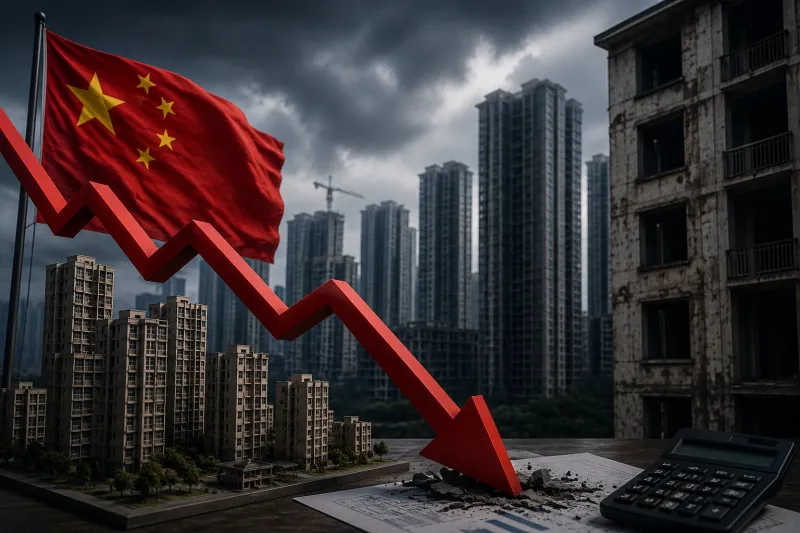

KKR and AEW cut China property exposure, locking in painful losses as exits accelerate
Global real estate investors are increasingly choosing certainty over optionality in China, and two prominent names—KKR and AEW—are emblematic of that shift. Both firms have been moving to reduce or exit China property holdings at sizable losses, reflecting a recalibration of risk after years of market stress, falling valuations, and tighter financing conditions. Their actions highlight how capital is repricing China real estate and how exit routes, once assumed to be plentiful, now demand compromises on price, timing, and structure.
- What is driving the push to exit now
- Why losses are becoming the cost of liquidity
- KKR’s repositioning signals a broader shift in private equity real estate
- AEW’s exit efforts reflect pressures on open- and closed-end fund structures
- Valuations have reset, but the market is still debating the floor
- The exit routes are narrower: strategic sales, secondary trades, and structured deals
- Currency and capital controls add an extra layer to return outcomes
- Policy support helps at the margins, but confidence is harder to restore
- How these exits can influence market pricing and peer behavior
- What global allocators are doing instead: reweighting Asia without abandoning it
What is driving the push to exit now
Several forces are converging to make exits more urgent. Weak demand across residential and commercial segments, persistent deflationary pressure, and subdued confidence among households and businesses have undermined cash flows and transaction volumes. At the same time, investors are contending with a higher global cost of capital, which compresses leveraged returns and reduces the amount buyers can pay. For foreign managers, the equation is further complicated by currency moves, repatriation considerations, and a risk premium that has widened for China exposure relative to other Asia-Pacific markets.
Why losses are becoming the cost of liquidity
In a thin market, price discovery shifts in favor of the marginal buyer. Sellers that need liquidity because of fund lifecycles, redemption pressure, or internal rebalancing often accept discounts to appraised values. Those discounts can look like “significant losses” when compared with peak-era underwriting, but they may also reflect a more realistic view of future income growth, tenant risk, and refinancing costs. For many institutional portfolios, taking a loss can be preferable to extended uncertainty, especially if holding periods extend beyond fund terms or if capex requirements rise as assets compete for tenants.
KKR’s repositioning signals a broader shift in private equity real estate
KKR’s move to reduce China property exposure fits a pattern seen among large alternative managers: prioritize markets where financing is more predictable, exits are more liquid, and cash yields can be defended. In practice, this means shifting attention toward segments such as logistics in select jurisdictions, multifamily where demographics and policy are supportive, and credit strategies that sit higher in the capital stack. The key takeaway is not that global capital is abandoning Asia, but that it is becoming more selective—demanding higher risk-adjusted returns and clearer downside protection than China property has recently offered.
AEW’s exit efforts reflect pressures on open- and closed-end fund structures
AEW’s decision to move toward an exit at a loss underscores how fund mechanics can dictate timing. Closed-end vehicles face maturity dates and distribution expectations, while open-end funds must manage subscriptions and redemptions against asset liquidity. When transaction volumes are low, meeting those obligations can require selling the most marketable assets first, often at prices below earlier valuations. This can create a feedback loop: fewer comparable trades lead to valuation uncertainty, which further discourages buyers, increasing the discount required to close deals.
Valuations have reset, but the market is still debating the floor
China property pricing has repriced meaningfully, yet investors still disagree on where “fair value” sits. Appraisals can lag reality when there are limited transactions, and underwriting assumptions rent growth, occupancy, capex, and exit cap rates vary widely depending on macro views. Many buyers are now stress-testing scenarios with lower terminal values and higher refinancing margins, while sellers may anchor to historical highs or to book values that have not fully absorbed the new risk premium. Until more deals print at scale, the floor will remain contested, prolonging the gap between bid and ask.
The exit routes are narrower: strategic sales, secondary trades, and structured deals
In today’s environment, straightforward asset sales to broad buyer pools are less common. Instead, exits often happen through a smaller set of channels.
- Strategic buyers with long-term horizons and local operating capability.
- Secondary market transactions involving fund stakes or joint venture interests rather than direct real estate.
- Structured solutions such as preferred equity, earn-outs, vendor financing, or partial recapitalizations.
These structures can bridge valuation gaps, but they also add complexity and can leave sellers with residual exposure, meaning “exit” may be incremental rather than immediate.
Currency and capital controls add an extra layer to return outcomes
For foreign investors, realized performance is not only about local asset prices but also about the translation into home currencies and the timing of cash repatriation. Currency weakness can magnify losses even if local valuations stabilize, while delays in moving capital can extend exposure to market and policy volatility. These factors encourage managers to favor simpler, faster cash realizations even at lower prices over prolonged negotiations that may deliver a higher headline valuation but increase execution risk.
Policy support helps at the margins, but confidence is harder to restore
Authorities have introduced measures intended to stabilize property markets, support developers, and improve funding access. Yet for institutional investors, the primary question is whether policy can restore durable demand and predictable cash flows. Commercial real estate performance depends on business formation, consumption, and corporate expansion—areas where sentiment matters as much as liquidity. Even if policy reduces near-term stress, many global allocators still require evidence of sustained improvement before increasing exposure, especially given competing opportunities in other regions with clearer growth trajectories.
How these exits can influence market pricing and peer behavior
High-profile disposals by established managers can shape benchmarks and expectations. If sales clear at steep discounts, they may reset comparable pricing, forcing other owners to mark down values and reconsider hold-versus-sell decisions. Conversely, if well-structured exits attract credible buyers, they can demonstrate that liquidity still exists, albeit at a price, and encourage more transactions. Either way, the actions of firms like KKR and AEW may accelerate the market’s transition from appraisal-driven valuations to trade-driven reality.
What global allocators are doing instead: reweighting Asia without abandoning it
Rather than a blanket retreat from Asia, many institutions are reweighting exposure by geography and strategy. Common adaptations include:
- Favoring markets with deeper liquidity and transparent governance frameworks.
- Prioritizing income durability over cyclical upside, with tighter tenant-credit screening.
- Leaning toward real estate credit or senior positions to reduce downside risk.
- Requiring higher underwriting hurdles for development or value-add plays.
In that context, the exits by KKR and AEW read less like a verdict on real estate as an asset class and more like a pragmatic response to where risk is being paid and where it is not.
Writer focused on delivering informative, accessible content