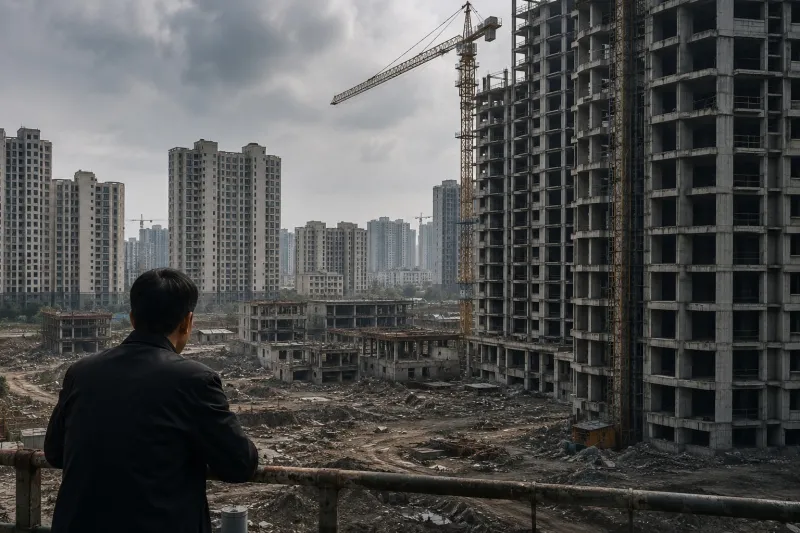

Binzhou’s housing trade-in plan: China tests a new lever to revive property demand
Binzhou, a city in China’s Shandong province, has rolled out a housing trade-in scheme designed to lower the friction of moving and rekindle demand in a sluggish property market. By encouraging households to swap older homes for newly built units—often with institutional support to handle the resale process—the policy aims to unlock pent-up upgrading demand, reduce inventories, and restore confidence without relying solely on broad, nationwide stimulus.
- Why Binzhou is turning to trade-ins now
- How a housing trade-in scheme typically works
- The demand problem the program is trying to solve
- Inventory reduction and the push to absorb new supply
- Who benefits most: upgraders, developers, and service platforms
- Pricing, valuation, and the risk of mismatched expectations
- Financing mechanics: down payments, bridge periods, and mortgage rules
- What it signals about China’s policy direction in housing
- Potential side effects: secondary-market pressure and unequal support
- What to watch next: participation rates, delivery confidence, and scaling
Why Binzhou is turning to trade-ins now
Like many lower-tier Chinese cities, Binzhou faces a familiar mix of challenges: softer household expectations, slower transaction volumes, and a backlog of unsold new homes. Against this backdrop, a trade-in model targets a key bottleneck homeowners who want to upgrade but hesitate because selling their current property can take time, involve price uncertainty, and complicate financing. By reducing these barriers, the city’s approach seeks to convert “I would buy if I could sell” into actual purchases.
How a housing trade-in scheme typically works
While specific mechanics vary by locality, a housing trade-in program generally creates a structured pathway for owners of existing homes to purchase a new unit first, with support to dispose of the old home. The process often includes assessment and pricing guidance, a temporary bridge arrangement, and coordination with developers and real estate agencies. The policy intent is not only to stimulate sales, but also to make upgrading feel administratively simple and financially predictable.
Common building blocks include:
- Pre-evaluation of the old home to set expectations on resale value
- Priority purchase access or discounts on designated new projects
- Support from platform companies or state-linked entities to list and market the old home
- Time-limited guarantees or commitments to reduce the risk of being stuck with two properties
The demand problem the program is trying to solve
In a downcycle, households delay big-ticket purchases because they fear further price declines, worry about job stability, and doubt whether developers will deliver. Even families with a clear need more space, better schools, newer buildings may postpone if they cannot confidently sell their current home at a reasonable price. Trade-in schemes attempt to address this “two transactions” dilemma by bundling the sale and purchase into a more coherent experience, shortening the decision window and reducing perceived risk.
Inventory reduction and the push to absorb new supply
For local governments, the priority is often to reduce unsold inventory and stabilize land and tax-related revenues linked to property activity. If trade-ins successfully shift households from older stock into newly built units, developers can clear existing supply faster, and the market can regain some momentum. The old homes re-enter the secondary market, potentially improving the match between housing types and buyer budgets, while the primary market benefits from a direct demand injection.
Who benefits most: upgraders, developers, and service platforms
The most immediate beneficiaries are typically owner-occupiers looking to upgrade families seeking larger layouts, elevators, better amenities, or access to preferred school districts. Developers gain from higher conversion rates and reduced marketing costs if buyers are funneled through an official program. Real estate agencies and transaction service platforms can also benefit through increased listings, standardized processes, and potentially higher throughput. In the best case, the scheme creates a coordinated pipeline from old stock to new stock.
Pricing, valuation, and the risk of mismatched expectations
Valuation is the stress test of any trade-in initiative. If homeowners expect yesterday’s peak prices while buyers are anchored to today’s discounts, transactions stall. Programs may try to narrow the gap through standardized appraisals, transparent comparable-sales data, or limited guarantees. But if pricing support is too generous, it can create hidden subsidies or distort market signals. If it is too conservative, households may not participate. Managing these expectations is essential to keeping volumes steady and complaints low.
Financing mechanics: down payments, bridge periods, and mortgage rules
Trade-ins intersect with mortgage policy in sensitive ways. A household may need proceeds from the old home to fund the down payment on the new one, yet the purchase timeline can be tight. Some schemes address this with a bridge period that allows the buyer to secure a new unit while the old one is marketed, or with structured payment schedules negotiated with developers. However, local implementation must align with broader credit rules, lender risk appetites, and household debt constraints, otherwise the program becomes administratively attractive but financially impractical.
What it signals about China’s policy direction in housing
Binzhou’s move fits a broader pattern of city-level experimentation aimed at stabilizing housing without launching a single, sweeping nationwide rescue. Rather than pushing demand through blunt stimulus alone, localities are using targeted tools that reduce transaction friction, encourage upgrades, and support the completion and sale of new homes. The emphasis is increasingly on “stabilization” and “risk reduction” through incremental mechanisms programs that can be scaled up, adjusted, or withdrawn depending on results.
Potential side effects: secondary-market pressure and unequal support
Moving more older homes onto the resale market can increase competition among sellers, potentially putting downward pressure on second-hand prices especially in neighborhoods with aging stock and weaker demand. That may be acceptable if the policy goal is to improve affordability and liquidity, but it can also dent household wealth perceptions. Another concern is uneven access: trade-in programs often focus on selected projects and eligible homes, which may favor certain developers or districts. Careful program design is needed to avoid perceptions of unfairness or implicit bailouts.
What to watch next: participation rates, delivery confidence, and scaling
The effectiveness of Binzhou’s scheme will hinge on measurable uptake and the smooth execution of transactions. Key indicators include the number of participating households, the average time to resell traded-in homes, discount levels required to close deals, and whether new-home inventories fall meaningfully. Just as important is buyer confidence in delivery if households remain worried about project completion, a trade-in pathway alone may not be enough. If early data show improved conversion and manageable risks, similar models could be replicated across other cities seeking pragmatic, locally tailored demand support.
Writer focused on delivering informative, accessible content