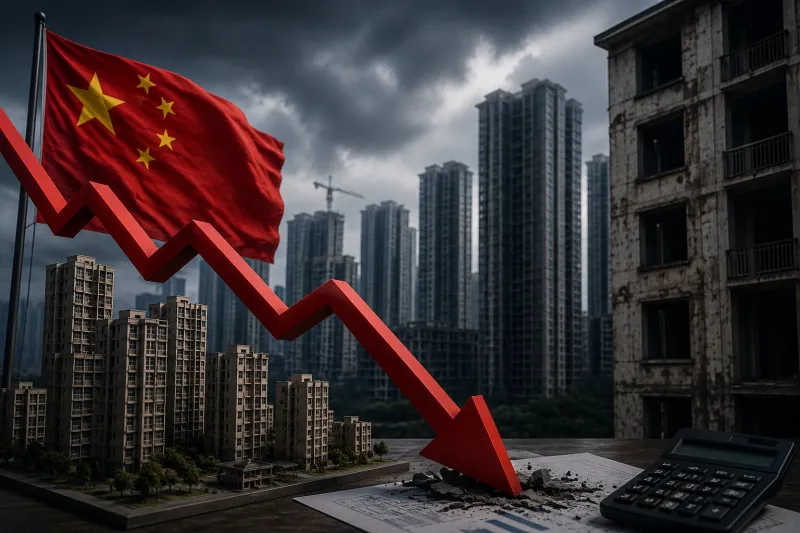

China’s housing downturn worsens as prices slide for a third straight month
China’s property slump is deepening as official data and market indicators point to a third consecutive month of falling home prices, reinforcing worries about weak demand, strained developer balance sheets, and the broader drag on consumption and local-government finances. Despite incremental policy easing, buyers remain cautious, inventories are elevated in many cities, and confidence has yet to reset—raising the stakes for Beijing’s next steps to stabilise a sector that has long been central to growth.
- Falling prices signal a confidence problem, not just a cyclical dip
- Weak demand is being reinforced by income uncertainty and demographics
- Developer stress keeps supply high and pricing power low
- The new-home market and resale market are diverging in key ways
- Tier-1 resilience is fading while lower-tier cities face heavier inventory
- Mortgage policy easing helps at the margin, but expectations drive decisions
- Local governments are squeezed as land-sale revenue remains depressed
- Household wealth effects are weighing on consumption and private spending
- Bank exposure looks manageable on paper, but second-order risks persist
- Beijing’s stabilisation toolkit is expanding, but execution is the hard part
Falling prices signal a confidence problem, not just a cyclical dip
Three months of price declines matter because housing in China is not merely a consumer good; it has functioned as a primary household store of wealth and a key collateral asset across the economy. When prices drift lower for several months, potential buyers interpret it as a sign to wait for better deals, while existing owners become more reluctant to trade up. This feedback loop suppresses transaction volumes and pushes developers to offer deeper discounts, making the correction feel structural rather than seasonal.
Weak demand is being reinforced by income uncertainty and demographics
Homebuying appetite is being constrained by slower wage growth, heightened job-market uncertainty especially among younger workers and a demographic profile that is less supportive of sustained housing demand. Even where mortgage rates have been cut, the decision to buy hinges on expectations of future income and price stability. In many cities, households are prioritising liquidity and caution, and the pool of first-time buyers is pressured by fewer new households forming and a reduced pipeline of migrants with the capacity to purchase.
Developer stress keeps supply high and pricing power low
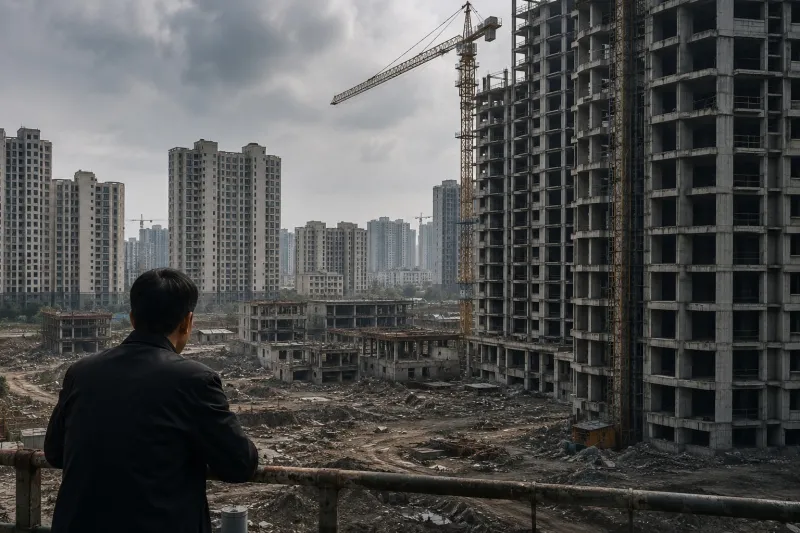
Many developers remain under financial strain, limiting their ability to slow construction in an orderly way or to refinance maturing obligations on favourable terms. To generate cash, firms often rely on accelerated pre-sales, promotions, and bulk discounts, which can pull headline prices down even in stronger districts. The presence of unfinished projects also damages trust: buyers are wary of committing capital when delivery risk persists, and that scepticism lowers effective demand for new homes precisely when developers need it most.
The new-home market and resale market are diverging in key ways
Pricing dynamics are increasingly shaped by the interaction between new-home discounts and resale competition. Developers can use incentives, bundled renovations, or hidden price cuts that are not always visible in advertised averages, while resale owners may undercut asking prices to secure liquidity. In some localities, the resale market is acting as the true clearing mechanism, forcing benchmark expectations lower. This divergence complicates policy assessment because stabilising one segment does not automatically lift the other.
Tier-1 resilience is fading while lower-tier cities face heavier inventory
Top-tier cities have generally held up better due to deeper labour markets, stronger fiscal capacity, and persistent demand for quality locations. However, even these markets are not immune when buyer sentiment turns and financing conditions remain cautious. In many lower-tier cities, the challenge is more acute: inventories are higher, population inflows are weaker, and the product mix can be poorly aligned with current preferences. As a result, price declines can be more persistent and more sensitive to promotional activity.
Mortgage policy easing helps at the margin, but expectations drive decisions
Measures such as lower mortgage rates, reduced down-payment requirements, and relaxed purchase restrictions can improve affordability on paper. Yet affordability is not the only obstacle; expectations about future prices and delivery certainty often matter more. If households believe prices will continue to fall, they may treat cheaper financing as a reason to wait rather than a reason to buy. This makes the policy transmission mechanism weaker and forces authorities to balance incremental easing with more direct confidence-building steps.
Local governments are squeezed as land-sale revenue remains depressed
Property market weakness continues to strain local-government finances because land sales have historically been a major revenue source funding infrastructure and public services. When developers pull back from land purchases, auctions fail or clear at lower prices, constraining budgets and raising pressure on local financing vehicles. This can slow investment and reduce the capacity for local counter-cyclical support, creating a tighter loop between property weakness and subnational fiscal stress.
Household wealth effects are weighing on consumption and private spending
As housing represents a large share of household assets, even modest price declines can dampen perceived wealth and encourage precautionary saving. Consumers may delay big-ticket purchases, reduce discretionary spending, or prioritise paying down debt. This is especially relevant in an economy seeking more consumption-led growth. When housing sentiment weakens, it can spill over into areas such as home furnishings, appliances, and services tied to moving and renovation slowing activity beyond construction itself.
Bank exposure looks manageable on paper, but second-order risks persist
China’s financial system has buffers, and regulators have tools to contain acute stress. Still, prolonged property weakness can raise second-order risks through several channels: higher non-performing loans in mortgages or developer credit, weaker collateral values, and reduced cash flow for firms connected to construction. The bigger vulnerability is confidence: if households doubt that projects will be completed, mortgage boycotts or payment delays become more likely, increasing pressure on lenders and local authorities to coordinate rescues.
Beijing’s stabilisation toolkit is expanding, but execution is the hard part
Policymakers have signalled a willingness to support the sector through a mix of targeted credit, project completion funding, demand-side easing, and initiatives to absorb excess inventory sometimes framed as converting unsold homes into social or affordable housing. The effectiveness of these steps depends on implementation details:
- Speed of funds reaching stalled projects
- Clarity on who bears losses among developers, creditors, and local entities
- Governance to prevent moral hazard while restoring delivery confidence
Without credible, visible progress on completion and price stabilisation, incremental easing risks being overshadowed by entrenched expectations of further declines.
Writer focused on delivering informative, accessible content