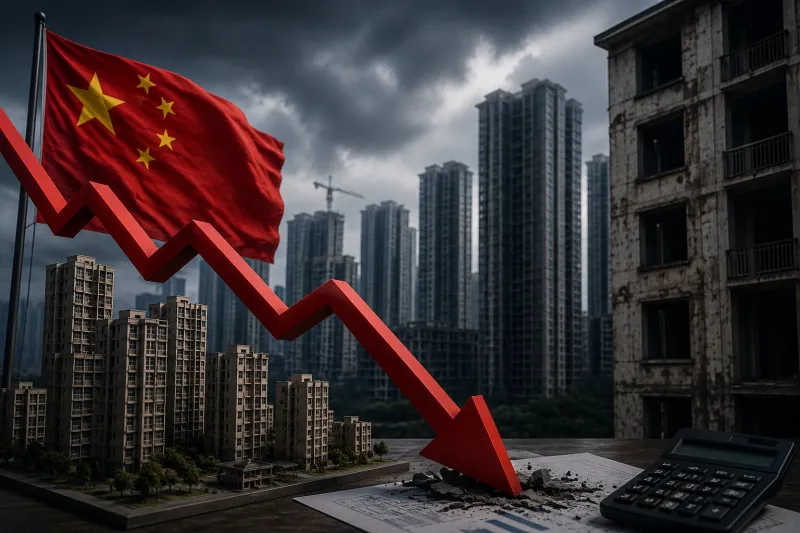

China tightens housing rules as Beijing tries to defuse property market risks
China is tightening housing rules again, aiming to contain financial risks that have accumulated in the property sector while steering the market toward a more sustainable footing. The shift reflects Beijing’s effort to balance multiple goals at once: preventing a renewed debt-driven real-estate boom, protecting households and banks from sharp price swings, and keeping construction and local-government finances from deteriorating further.
- Why Beijing is tightening rules now
- What “tightening” can include in China’s housing toolkit
- Managing developer debt and preventing new leverage
- Mortgage policy and the message to households
- Presales, escrow supervision, and finishing homes
- Local governments: land sales, budgets, and policy trade-offs
- Tiered city approach: why the rules differ by location
- Impact on banks, shadow finance, and overall credit conditions
- Construction, employment, and the wider economy
- What to watch next: enforcement, exemptions, and market signals
Why Beijing is tightening rules now
Policymakers are reacting to a familiar set of vulnerabilities: high developer leverage, weak homebuyer confidence, unfinished projects, and local governments that still rely heavily on land-related income. Even when sales briefly stabilize, authorities remain wary of a rebound powered by speculative demand and easy credit.
The renewed tightening is therefore less about cooling an overheated market nationwide and more about preventing pockets of risk from snowballing into broader financial stress.
In practice, that means targeting the channels through which risk spreads developer financing, mortgage underwriting, and the use of housing as collateral while preserving flexibility for cities where inventories are high and prices are still under pressure.
What “tightening” can include in China’s housing toolkit
China’s housing policy is often implemented through a menu of measures that can be dialed up or down across cities. Tightening does not necessarily mean a single nationwide ban; it typically combines administrative controls with credit guidance.
- Purchase restrictions that limit the number of homes a household can buy or require local residency records.
- Higher down-payment ratios for second homes, or stricter verification of buyer funds.
- Mortgage rate floors and tighter debt-to-income checks to curb over-borrowing.
- Controls on presales and escrow funds to ensure construction money is used for delivery.
- Limits on developer leverage and stricter rules for bond issuance or trust financing.
These levers allow Beijing to clamp down on speculation while trying to avoid a sudden stop in legitimate end-user demand.
Managing developer debt and preventing new leverage
A core objective is to stop developers from returning to the high-debt model that previously fueled rapid expansion. Tighter rules can constrain access to off-balance-sheet funding, reduce the ability to roll over liabilities, and increase scrutiny of connected-party transactions that obscure leverage.
At the same time, Beijing has incentives to differentiate between developers. Firms with healthier balance sheets and stronger execution may retain financing access, while highly leveraged players face stricter conditions. This selective discipline is designed to reduce systemic risk without triggering indiscriminate defaults that could spill into banks, suppliers, and households.
Mortgage policy and the message to households
Tighter housing rules often signal that authorities want housing to remain primarily a consumption good rather than a speculative asset. Mortgage adjustments can reinforce that message by making it more expensive or harder to buy multiple properties, especially in high-tier cities where price expectations can reignite quickly.
For households, the practical impact is felt through stricter documentation, higher required down payments for non-first-time purchases, and closer monitoring of consumer loans that are sometimes diverted into down payments. Policymakers aim to reduce the probability of households becoming overextended, which would amplify stress if prices fall or incomes weaken.
Presales, escrow supervision, and finishing homes
One of the most sensitive issues in China’s property market has been delivery risk: apartments sold in advance but not completed. Tightening can involve stricter supervision of presale proceeds, requiring more funds to remain in escrow accounts and limiting withdrawals until construction milestones are verified.
This reduces liquidity flexibility for developers, but it can improve buyer confidence by prioritizing completion. Authorities may also strengthen auditing and reporting obligations for project accounts, making it harder to shift funds between projects. In effect, Beijing is trying to align incentives so that delivery comes before expansion.
Local governments: land sales, budgets, and policy trade-offs
Housing tightening has direct consequences for local-government finances because land-transfer fees and related taxes have historically supported spending. When sales slow, fiscal pressure rises, especially in areas with large infrastructure commitments.
This creates a policy trade-off. Beijing wants to suppress risky speculation, but it also needs localities to maintain services and manage debt. As a result, tightening may be stricter in cities with stronger demand and more speculative pressure, while weaker markets may receive offsetting support such as targeted credit for first-time buyers, housing vouchers, or accelerated social-housing programs.
Tiered city approach: why the rules differ by location
China’s housing market is not one market. First-tier and many second-tier cities can experience rapid price momentum and investor demand, while smaller cities may face oversupply and declining populations. Beijing’s tightening is therefore typically implemented through a tiered framework.
In hotter markets, authorities may prioritize purchase caps, resale restrictions, and tougher mortgage terms. In softer markets, they may focus more on cleaning up developer balance sheets and ensuring completion, rather than suppressing already-weak demand. The goal is to reduce national financial risk while allowing local adjustments that reflect local fundamentals.
Impact on banks, shadow finance, and overall credit conditions
Banks remain heavily exposed to property through developer loans, mortgages, and lending to industries linked to construction. Tighter housing rules can reduce new risk formation, but they may also slow credit growth in a sector that has long been a major economic engine.
Authorities also watch non-bank channels such as trust products and wealth-management instruments that can repackage property exposure. Strengthened supervision can limit regulatory arbitrage, forcing more lending onto balance sheets where it is easier to monitor. The broader effect is a shift toward more controlled, policy-guided credit, rather than exuberant market-driven expansion.
Construction, employment, and the wider economy
Real estate and construction affect a large ecosystem: contractors, building materials, appliances, brokerage services, and household consumption tied to moving and renovations. When rules tighten, activity can cool quickly, which raises concerns about employment and confidence.
Beijing’s challenge is to reduce property-market risks without causing a sharp contraction that drags on growth. This is why tightening is often paired with measures that support completion of existing projects, protect homebuyers, and direct investment toward public housing or urban renewal channels that can sustain some construction demand while limiting speculative excess.
What to watch next: enforcement, exemptions, and market signals
The effectiveness of tighter housing rules depends heavily on enforcement and on whether exemptions proliferate. Investors and households will watch how strictly local authorities apply purchase restrictions, how banks interpret mortgage guidance, and whether developers can still access alternative financing.
Key indicators include changes in mortgage approval times, shifts in down-payment requirements, land-auction outcomes, and the pace of project delivery. If tightening is credible and consistent, it can dampen speculative expectations. If implementation is uneven, demand may simply re-route to less regulated channels or neighboring cities, limiting the impact on systemic risk.
Writer focused on delivering informative, accessible content