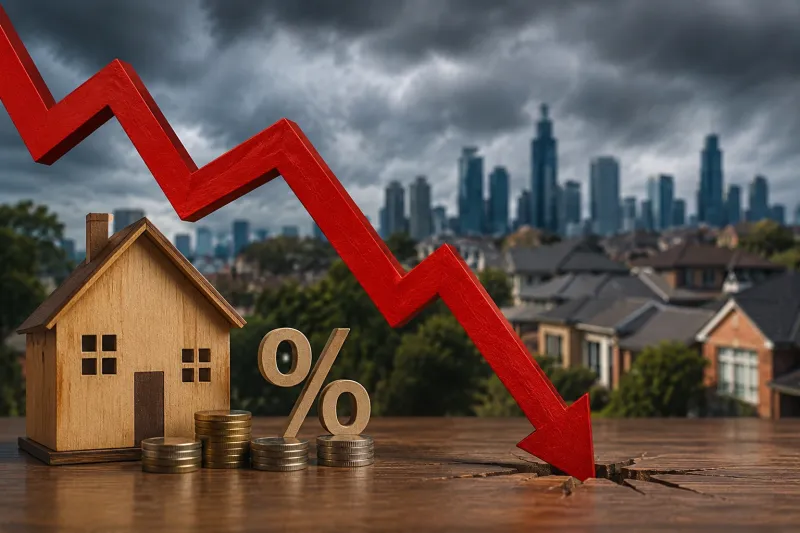
Australia’s housing downturn deepens as prices slide across most suburbs
Australia’s housing market is losing momentum in a way that feels broader and more persistent than earlier soft patches: price declines are spreading across suburbs, clearance rates are cooling, and sellers are adjusting expectations. While conditions still vary sharply by city and property type, the common thread is a shift in bargaining power—away from vendors and toward buyers—driven by higher borrowing costs, stretched affordability, and a growing preference for waiting rather than overpaying.
- A downturn that is becoming more widespread
- Interest rates are reshaping buyer budgets
- Falling prices do not mean falling living costs
- Auctions and private treaty sales are sending different signals
- Vendor expectations are catching up to the new reality
- Why some suburbs are falling faster than others
- Investors are recalculating returns amid tighter conditions
- Supply is rising, but not evenly across the country
- What buyers are doing differently in a cooling market
- Policy, lending settings, and the next leg of price discovery
A downturn that is becoming more widespread
The key signal in the current phase is breadth. Price falls concentrated in a handful of overheated pockets are being replaced by declines across a larger share of suburbs, suggesting a market-wide repricing rather than isolated weakness. When most suburbs in a city start printing negative monthly or quarterly changes, it typically reflects reduced buyer capacity rather than simply a change in preferences between neighborhoods. That matters because broad-based declines can become self-reinforcing: softer comparable sales feed bank valuations, lower valuations reduce borrowing limits, and reduced borrowing limits suppress offers.
Interest rates are reshaping buyer budgets
Higher mortgage rates continue to do the heaviest lifting in cooling prices. Even if wage growth is positive, it has not consistently offset the jump in repayment costs, pushing many households to lower their maximum bid or exit auctions entirely. The impact is especially sharp for recent entrants who must borrow at high loan-to-income multiples, because small rate changes translate into large repayment differences on large principal amounts. In practical terms, buyers are increasingly optimizing around weekly repayments, not sticker prices, and that arithmetic is pressuring values across mainstream family suburbs as well as inner-city markets.
Falling prices do not mean falling living costs
Many would-be buyers expected that price declines would quickly restore affordability, but the reality is more complicated. Insurance, strata fees, utilities, childcare, and general inflation can keep the total cost of owning high even as property values slip. For renters hoping to buy, elevated rents can erode the ability to save deposits, while for owners, higher household expenses reduce the buffer available for mortgage servicing. This combination can create a market where prices fall yet households still feel financially squeezed, limiting demand recovery.
Auctions and private treaty sales are sending different signals
In auction-heavy markets, sentiment shifts show up first in clearance rates, bidder counts, and the size of the gap between reserve prices and top bids. In private treaty markets, the adjustment is visible in discounting, longer days on market, and a higher proportion of listings with multiple price reductions. Together, these indicators point to sellers having to work harder: better presentation, sharper pricing, and more flexibility on terms. As buyers become more selective, well-located homes with strong fundamentals can still transact, but the market is less forgiving of compromised layouts, noisy streets, or deferred maintenance.
Vendor expectations are catching up to the new reality
Downturns often deepen when sellers resist repricing, causing listings to linger and stale stock to build. Over time, holding costs and missed opportunities push vendors to accept the market’s level. The current environment is accelerating that process because many owners are juggling refinancing, higher variable-rate repayments, or fixed-rate roll-offs. Where sellers must transact due to separation, relocation, or financial stress price discovery can occur quickly, and those sales reset suburb benchmarks in ways that affect even discretionary sellers.
Why some suburbs are falling faster than others
Not all declines are created equal. Suburbs that surged most during the low-rate era often those with high investor participation or large numbers of recent buyers tend to be more sensitive to rate shocks. Areas dominated by highly leveraged households can see sharper pullbacks as borrowing power drops. Meanwhile, prestige segments can be more volatile because fewer comparable sales can move medians, and discretionary buyers may pause when economic uncertainty rises. Structural factors also matter: proximity to jobs, transport, and school catchments can cushion falls, while oversupplied corridors or regions with weaker employment growth may underperform.
Investors are recalculating returns amid tighter conditions
Investors face a different equation from owner-occupiers, and it has become less attractive in many suburbs. Higher interest costs have increased the size of cash-flow shortfalls for leveraged landlords, while lending standards and serviceability buffers limit additional purchases. Some investors are holding because rental markets remain tight, but others are selling to reduce exposure or lock in gains from earlier years. The result is a more price-sensitive investor cohort that demands stronger yields or better entry prices, which can add downward pressure in suburbs where investors previously helped set the marginal price.
Supply is rising, but not evenly across the country
Even modest increases in listings can tip a market when demand is fragile. More choice reduces urgency, allowing buyers to negotiate harder and walk away more easily. However, supply patterns differ by city and region, shaped by construction pipelines, migration flows, and local economic conditions. In some areas, a lift in new listings reflects normal seasonality; in others, it may signal stress or a shift in sentiment. Where listing volumes rise at the same time as buyer confidence falls, discounts typically widen and prices tend to drift lower for longer.
What buyers are doing differently in a cooling market
Buyers are behaving more like underwriters than competitors. They are scrutinizing building reports, strata minutes, flood maps, and recent comparable sales with greater discipline, and they are less willing to waive conditions just to secure a contract. Common tactics include:
- Setting firm walk-away prices tied to repayment limits and bank valuations.
- Targeting motivated vendors by monitoring days on market and repeated price guides.
- Negotiating terms such as longer settlements or subject-to-finance clauses where possible.
This shift in behavior is a hallmark of a deepening downturn: it changes not just outcomes, but the day-to-day mechanics of transactions.
Policy, lending settings, and the next leg of price discovery
The path from here will hinge on the interaction between monetary policy, lending settings, and household income growth. Even without further rate rises, the market can keep softening if serviceability buffers remain tight, credit growth stays subdued, and consumer sentiment weakens. At the same time, any easing in financing conditions lower rates, looser buffers, or improved competition among lenders can quickly lift borrowing capacity and stabilize prices in interest-rate-sensitive suburbs. For now, the dominant dynamic is ongoing price discovery: buyers anchoring to conservative valuations and repayment constraints, and sellers gradually meeting them as evidence accumulates suburb by suburb.
Writer focused on delivering informative, accessible content